The Ultimate Home Sauna Buying Guide: Space, Heat, Red Light Therapy, and Smart Features
Oct 03, 2025
A home sauna can transform an ordinary wellness routine into something far easier to maintain. Instead of traveling to a spa, waiting for an appointment, or fitting sauna sessions around another facility’s schedule, an at-home model makes heat therapy available whenever it fits the day. However, choosing the right sauna requires more thought than simply finding a model that reaches a high temperature.
A home sauna can transform an ordinary wellness routine into something far easier to maintain. Instead of traveling to a spa, waiting for an appointment, or fitting sauna sessions around another facility’s schedule, an at-home model makes heat therapy available whenever it fits the day. However, choosing the right sauna requires more thought than simply finding a model that reaches a high temperature.
Modern infrared saunas come with different heating technologies, sizes, wood options, red light therapy systems, controls, electrical requirements, and additional wellness features. Some are designed specifically for solo sessions, while others provide enough room for two people. Some prioritize compact installation, while premium models add full-spectrum infrared heating, medical-grade red light therapy, app controls, Bluetooth audio, chromotherapy, and air-ionization systems.
For anyone researching a home sauna, understanding these differences can make the buying process considerably easier. A model should fit the available space, support the intended wellness routine, provide appropriate heat, and include features that will genuinely encourage consistent use.
Peak Saunas offers several configurations that illustrate how these considerations come together. The Peak Rainier is a one-person indoor sauna, while the Peak Fuji and Peak Everest provide two-person configurations. All three combine full-spectrum infrared heating with integrated medical-grade red light therapy and smart controls, while their construction and electrical requirements differ.
Why Home Infrared Saunas Are Becoming Part of Modern Wellness Spaces
Traditional sauna bathing has a long history, but infrared technology has helped make sauna environments more adaptable to residential spaces. Infrared heaters warm the body through infrared energy rather than relying exclusively on heating the surrounding air.
For homeowners, this can make an infrared sauna appealing as part of a broader home wellness environment. A sauna can sit alongside exercise equipment, stretching areas, meditation spaces, recovery tools, or a bedroom-based evening routine.
Research has also made sauna bathing an increasingly interesting area of wellness research. A long-term Finnish cohort study involving 2,315 middle-aged men found an association between more frequent sauna use and lower risks of several health outcomes. Importantly, the research examined sauna bathing generally rather than a specific infrared sauna brand or model, so these findings should not be interpreted as proof that a particular home sauna produces the same outcomes.
The practical lesson for buyers is simpler: consistency matters. A home sauna is most useful when its design makes regular use realistic.
That means size, location, controls, setup, comfort, and usability deserve as much attention as the heating system itself.
Start With Available Space and Sauna Size
One of the first questions in any home sauna buying guide should be where the sauna will actually go.
Indoor saunas require sufficient room for the cabin itself, access to the door, ventilation considerations, electrical connections, and enough surrounding space to make installation practical. Measuring the intended location before choosing a model can prevent an expensive mistake.
A one-person sauna can be particularly useful when floor space is limited. The Peak Rainier, for example, measures approximately 42 inches wide, 40 inches deep, and 75 inches high externally. Its interior measures approximately 38 inches wide, 36 inches deep, and 67 inches high. The configuration is designed around a single user while retaining the full-spectrum infrared and red light features found throughout the range.
For households with additional room, a two-person sauna provides a different experience. The Peak Fuji and Peak Everest both measure approximately 53 inches wide, 44 inches deep, and 75 inches high externally, with interiors measuring approximately 49 inches wide, 40 inches deep, and 67 inches high.
The difference is not simply about having another seat. A two-person sauna can make wellness sessions a shared household activity. It can also provide additional interior space for people who prefer a less confined environment.

One-Person vs. Two-Person: Which Configuration Makes Sense?
Choosing between a one-person and two-person sauna largely comes down to lifestyle and available space.
A one-person model is well suited to someone who expects to use the sauna alone and wants to minimize its footprint. The Rainier can be especially attractive for a dedicated personal wellness corner, bedroom-adjacent space, home gym, or another indoor location where every inch matters. It also uses a standard 120V household outlet, according to the manufacturer's specifications.
A two-person model makes more sense when couples or household members are likely to use the sauna together. The Fuji and Everest both accommodate two people and use a dedicated 120V/20A circuit.
The decision should also account for long-term use. A sauna may remain in the home for years, so choosing strictly according to current space without considering future routines can lead to disappointment. If two people regularly plan to use the sauna together, upgrading to a two-person configuration from the beginning may be more practical.
Understanding Infrared Heat Technology
Heat technology is one of the most important factors to investigate when comparing infrared saunas.
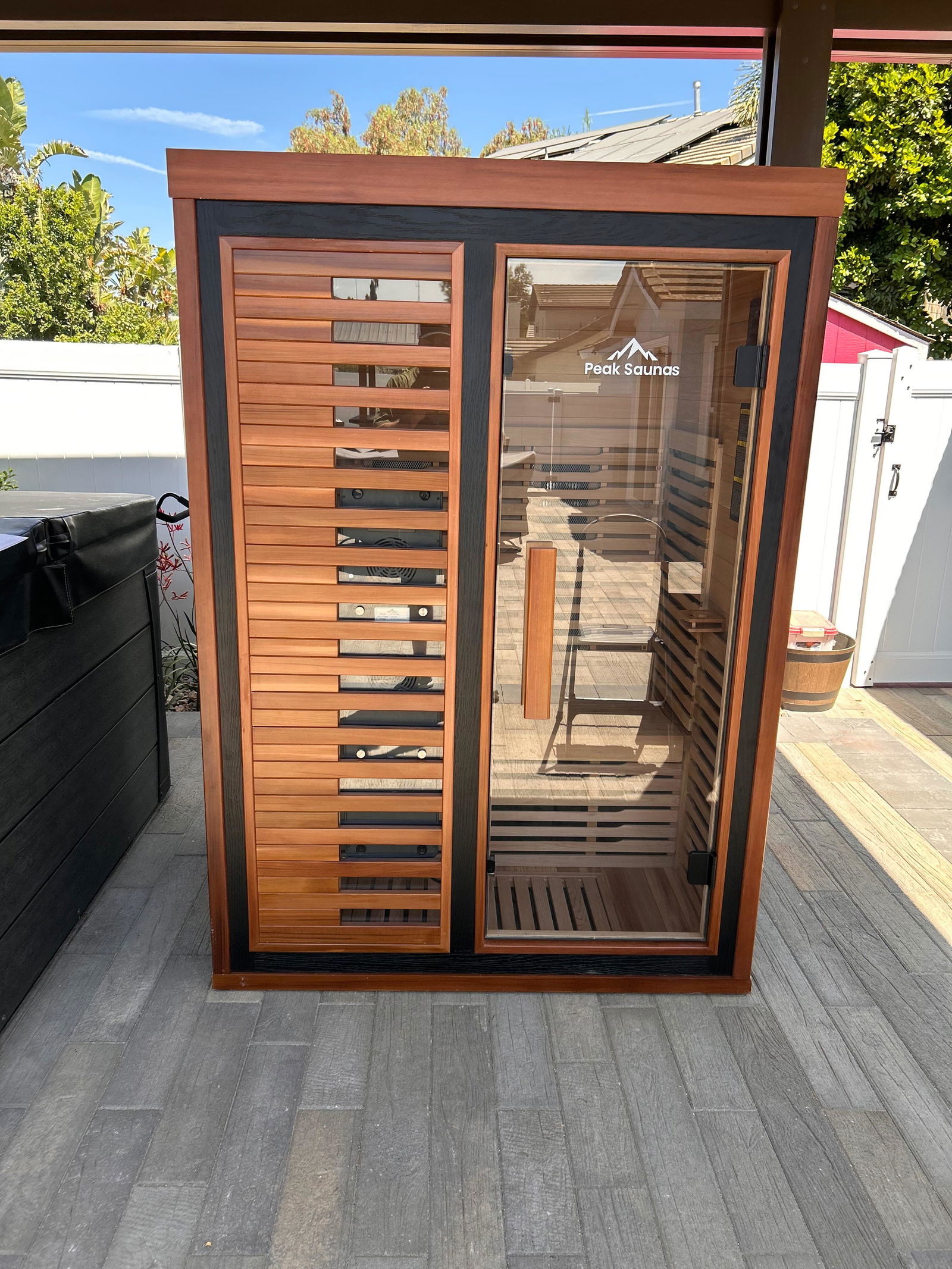
Full-spectrum infrared systems combine near-, mid-, and far-infrared wavelengths rather than relying on a single portion of the infrared spectrum. Peak's full-spectrum models use a combination of carbon far-infrared panels and halogen/quartz emitters, with the company specifying a range of approximately 700 to 25,000 nanometers.
This approach is designed to provide broad, full-body heat coverage while allowing the sauna to operate at temperatures associated with infrared sauna environments.
All three models considered in this guide are listed with a maximum temperature of up to 150°F. That gives buyers who want a hotter infrared session more flexibility than models with lower maximum temperatures.
However, maximum temperature should not be the only consideration. Heater placement, cabin design, heat distribution, session controls, and personal comfort can all affect the actual experience.
A sauna that is used consistently at a comfortable temperature may ultimately be more valuable than a model purchased solely because it advertises the highest possible temperature.
Why Red Light Therapy Has Become an Important Sauna Feature
Another major development in home wellness technology is the combination of infrared sauna heat with red light therapy.
Red light therapy uses specific wavelengths of light, and modern sauna systems can integrate dedicated panels into the cabin rather than requiring a separate device. This can simplify a wellness routine by allowing heat and light sessions to take place in the same environment.
Peak's Fuji, Everest, and Rainier models include a full-body medical-grade red light panel as standard. The panels use eight listed wavelengths ranging from 630nm to 1060nm and incorporate 216 high-output dual-chip LEDs. The manufacturer lists the panel dimensions at approximately 9 by 36 inches.
This is an important distinction for buyers because decorative red lighting and dedicated red light therapy equipment are not the same thing. A sauna may have red-colored ambient lighting purely for atmosphere, whereas a dedicated therapy panel is designed around specific wavelengths and light output.
For shoppers interested in combining different wellness technologies, integrated red light therapy can also eliminate the need to purchase and position a separate panel.
Consider the Red Light Therapy Coverage
Not every red light system provides the same coverage.
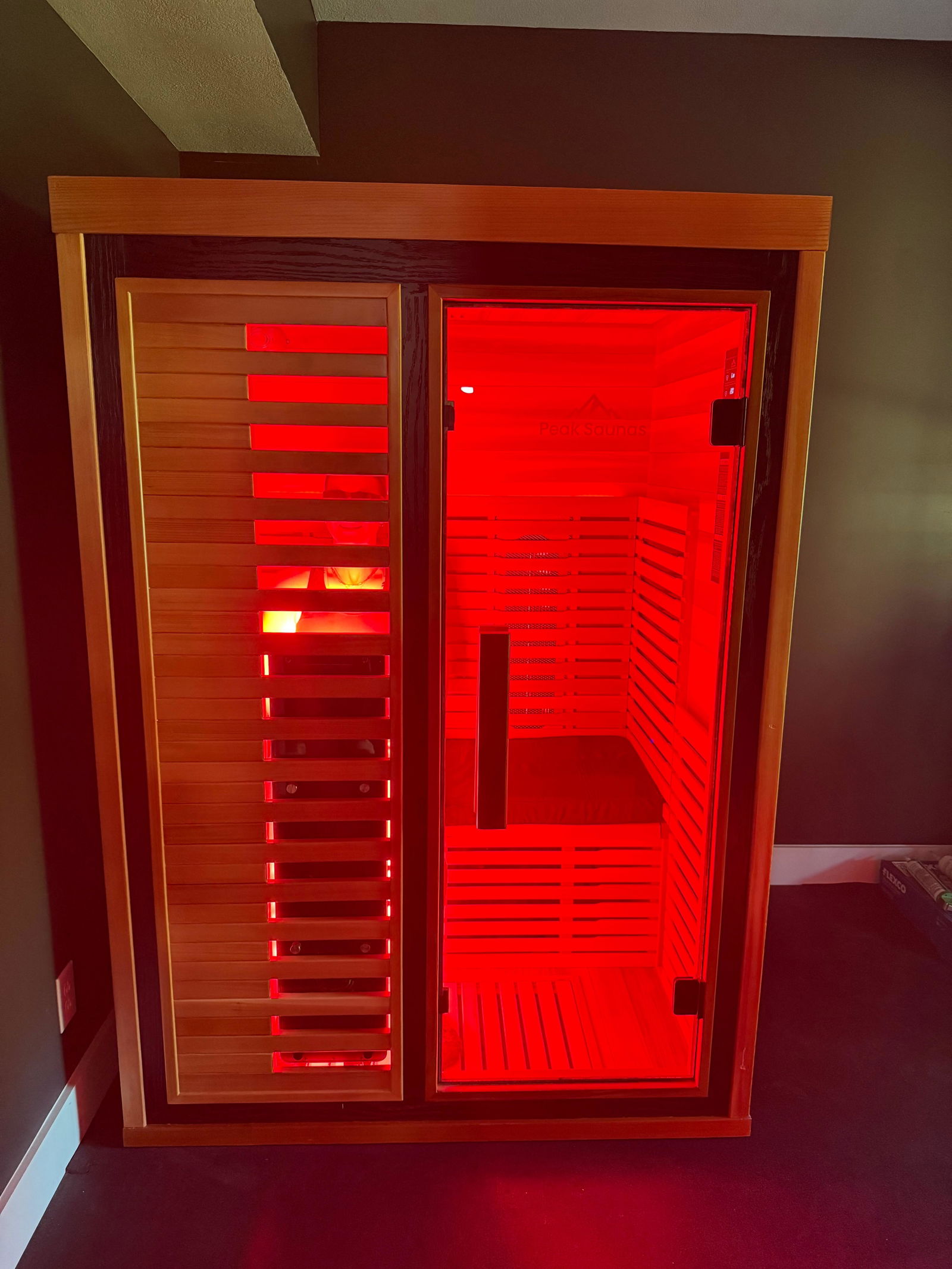
The placement of the panel matters because the objective is to expose relevant areas of the body to the intended light. Peak positions its large red light panel on the front wall of its full-spectrum models, allowing users to face the panel while seated. The company lists irradiance measurements at different distances from the panel, which can be useful for buyers comparing specifications.
This is an area where buyers should look beyond phrases such as “red light included.” More useful questions include the wavelengths used, panel dimensions, LED configuration, irradiance, placement, and available programs.
For anyone primarily interested in red light therapy, these specifications can be just as important as the sauna's heat technology.
Smart Controls Can Make a Sauna Easier to Use
A premium sauna can have excellent hardware, but convenience ultimately influences how often it gets used.
Smart controls can make that difference. The Peak Fuji, Everest, and Rainier include touchscreen controls and Wi-Fi app functionality for controlling the sauna remotely. The app allows users to preheat the sauna and adjust settings such as temperature, lighting, and session duration.
Remote control is particularly useful when the sauna is part of a structured routine. Instead of waiting beside the sauna while it heats, a user can prepare the environment before entering.
Scheduling can also encourage consistency. A sauna session can become associated with a particular time of day, such as after a workout, before a shower, or during an evening wind-down routine.
Smart features should therefore be evaluated as practical tools rather than simply luxury extras.
Look at the Interior Experience, Not Just the Specifications
A sauna is ultimately a space where someone spends time, so interior comfort deserves careful consideration.
Features such as seating, lighting, audio, temperature controls, and atmosphere can affect whether the sauna feels inviting enough for regular use.
The Fuji, Everest, and Rainier include two HiFi Bluetooth speakers, dual-level LED accent lighting, built-in chromotherapy, an oxygen-ionization system, and a foot-reflexology heater.
These features create an environment that can support relaxation beyond the basic function of producing heat.
For some buyers, the ability to listen to music or a podcast may make longer sessions more enjoyable. For others, subdued lighting and a quiet environment may be more valuable.
The best configuration depends on the type of wellness ritual the sauna is expected to support.
Pay Attention to Wood Construction
The type of wood used inside a sauna affects both appearance and atmosphere.
The Peak Fuji and Rainier are constructed from premium Canadian red cedar. Cedar is traditionally valued for its aromatic character and moisture resistance, making it a popular choice for sauna environments.
The Peak Everest uses premium Canadian hemlock. The company describes the material as naturally durable and non-toxic.
The choice between cedar and hemlock can therefore come down to personal preference, interior aesthetics, and the atmosphere desired from the space.
A sauna is likely to remain visible in a home for years, so choosing a finish and wood style that works with the surrounding interior can be worthwhile.
Consider EMF Specifications Carefully
Near-zero EMF is another specification that appears frequently in premium infrared sauna shopping.
For buyers who prioritize electromagnetic field measurements, it is important to look for transparent information rather than relying only on marketing terminology. Published measurements, testing methodology, and the conditions under which measurements were taken can provide more useful context.
The product configurations discussed here are marketed as near-zero EMF infrared saunas. Buyers should still review the manufacturer's current technical documentation and specifications when EMF performance is a deciding factor.
This is also a reminder that a sauna should be evaluated as a complete system. Heating technology, electrical design, construction, and other components all contribute to the overall product.
Check Electrical Requirements Before Ordering
Electrical requirements are easy to overlook during the initial research stage, yet they can become one of the most important installation considerations.
The Peak Rainier is specified at 120V/15A/1,800W and plugs into a standard household outlet. The Fuji and Everest are specified at 120V/20A/2,050W and require a dedicated 20-amp circuit.
That difference can affect where each model can be installed and whether an electrician needs to be involved.
Checking the electrical specifications before purchasing helps prevent installation surprises. The intended room, outlet location, circuit capacity, and local electrical requirements should all be considered.
Think About Assembly and Delivery
Large wellness equipment can be challenging to move into a home, particularly when it includes substantial wooden panels and glass components.
Peak describes its sauna cabins as modular, clasp-together designs requiring minimal tools. The company estimates that two adults can typically assemble the Fuji and Everest in around two hours, while the Rainier can typically be assembled by two adults in approximately 90 minutes.
Delivery is another consideration. Peak states that its saunas are shipped in protective crates and delivered through scheduled freight service within the continental United States.
Before ordering, homeowners should measure doorways, hallways, staircases, elevators, and the final installation area. A sauna may fit comfortably in the chosen room but still present challenges during delivery.
Compare the Peak Fuji, Everest, and Rainier
The three models offer a straightforward way to understand how sauna configurations can differ.
The Peak Rainier is the compact one-person option. It uses Canadian red cedar, provides full-spectrum infrared heat and a full-body red light panel, and plugs into a standard 120V/15A outlet. Its smaller dimensions make it appropriate for buyers prioritizing personal use and space efficiency.
The Peak Fuji expands the experience to two people and uses Canadian red cedar. It combines full-spectrum infrared heat, a full-body medical-grade red light panel, app control, Bluetooth audio, chromotherapy, oxygen ionization, and a foot-reflexology heater.
The Peak Everest is another two-person configuration but uses Canadian hemlock. It offers the same broad combination of full-spectrum infrared, integrated red light therapy, smart controls, audio, chromotherapy, air ionization, and foot heating.
All three models are listed with a maximum temperature of up to 150°F and a seven-year warranty, making the choice primarily about capacity, construction preferences, available space, and electrical requirements.
Make Consistency the Final Buying Consideration
The most sophisticated sauna in a product catalog is not necessarily the best sauna for every household.
A more useful question is whether the model will make regular use easy.
If a sauna is difficult to access, takes up too much space, lacks convenient controls, or requires complicated preparation, it may become an underused investment. Conversely, a properly sized sauna with comfortable features and straightforward controls can become a natural part of the weekly routine.
That is why factors such as app control, heating speed, interior comfort, red light integration, electrical requirements, and cabin size should be considered alongside the headline specifications.
The goal is not simply to own a sauna. The goal is to choose a setup that encourages consistent use.
Final Thoughts on Choosing a Home Sauna
Buying a home sauna is a significant wellness investment, and the right choice depends on much more than temperature alone. Space, capacity, heating technology, red light therapy, construction, electrical requirements, smart controls, and interior features all contribute to the overall experience.
For solo users with limited space, a compact model such as the Peak Rainier offers a dedicated one-person environment while retaining full-spectrum infrared and integrated red light therapy. For households seeking a shared experience, the two-person Peak Fuji and Peak Everest provide more interior capacity along with premium heating, red light, smart controls, and additional comfort features.
Ultimately, the strongest home sauna is the one that fits naturally into the home and the lifestyle of its users. When the space is right, the technology is appropriate, and the controls make regular sessions convenient, a sauna can become more than another piece of home equipment. It can become a dedicated space for relaxation, recovery, and a consistent wellness ritual.